
How to Check for a Warrant in St. Cloud
St. Cloud runs no warrant search of its own. The police department posts no warrant list either. What the city offers is a records route plus public-record links that lead to the state systems, so a real warrant check runs through the county that filed the case.
- Read the citation for the county, the court date, and the case number.
- Call the St. Cloud police information desk for the police report behind the citation.
- Search the case in the statewide court records system and open the case details if a warrant flag appears.
- Check the Benton County Sheriff's active warrant listing when the case is filed in Benton County.
- Call the court administration for the county named on the citation and ask what the case requires now.
- Talk with a lawyer before appearing in person, because the court warns that custody can follow when an arrest warrant exists.
Each St. Cloud step answers a different question. Jumping straight to the online search alone leaves the case detail unverified.
The St. Cloud Police Records Desk for Warrant Questions
The information desk is the city's public door for records in St. Cloud. Start there when you need the police side of a case. The desk confirms reports, citations, and agency records. It cannot confirm warrant status, since that question belongs to the court.
St. Cloud Police Information Desk
101 11th Avenue North, St. Cloud, MN 56303
320-345-4444
Non-emergency 320-251-1200. Weekday desk hours 8:00 a.m. to 4:30 p.m. Fax 320-650-3839.
The city's public records page gathers the official search links and repeats the desk contact. Note: Records questions and 911 emergencies travel different paths, so use 911 only when something is happening now.
The St. Cloud Police Department and Municipal Court
The St. Cloud Police Department makes arrests, writes citations, and investigates cases inside the city limits. What the city lacks is a municipal court issuing its own warrants. Minnesota runs a unified District Court instead, and the city's own materials send case and missed court questions to county court administration. For a St. Cloud reader, that means the police department and the court are two stops rather than one. The department answers for what its officers did. The District Court answers for what the case shows. A reader who treats them as a single office will get half an answer, so plan on both.
St. Cloud Prosecution and Warrant Case Files
Prosecution and court administration sit on opposite sides of the same case, and the split explains why a call to the wrong St. Cloud office produces no answer. The city attorney's office brings city ordinance charges plus state petty, misdemeanor, and certain gross misdemeanor matters. Court administration holds the file and the calendar a warrant attaches to.
| Office | What It Handles | Where to Ask |
|---|---|---|
| City attorney | Charging and prosecuting city ordinance and misdemeanor matters | The city office named on the notice |
| Court administration | The case file, appearances, and current warrant status | The county named on the citation |
St. Cloud's criminal division page lays out that charging scope and sends case questions to county court administration.
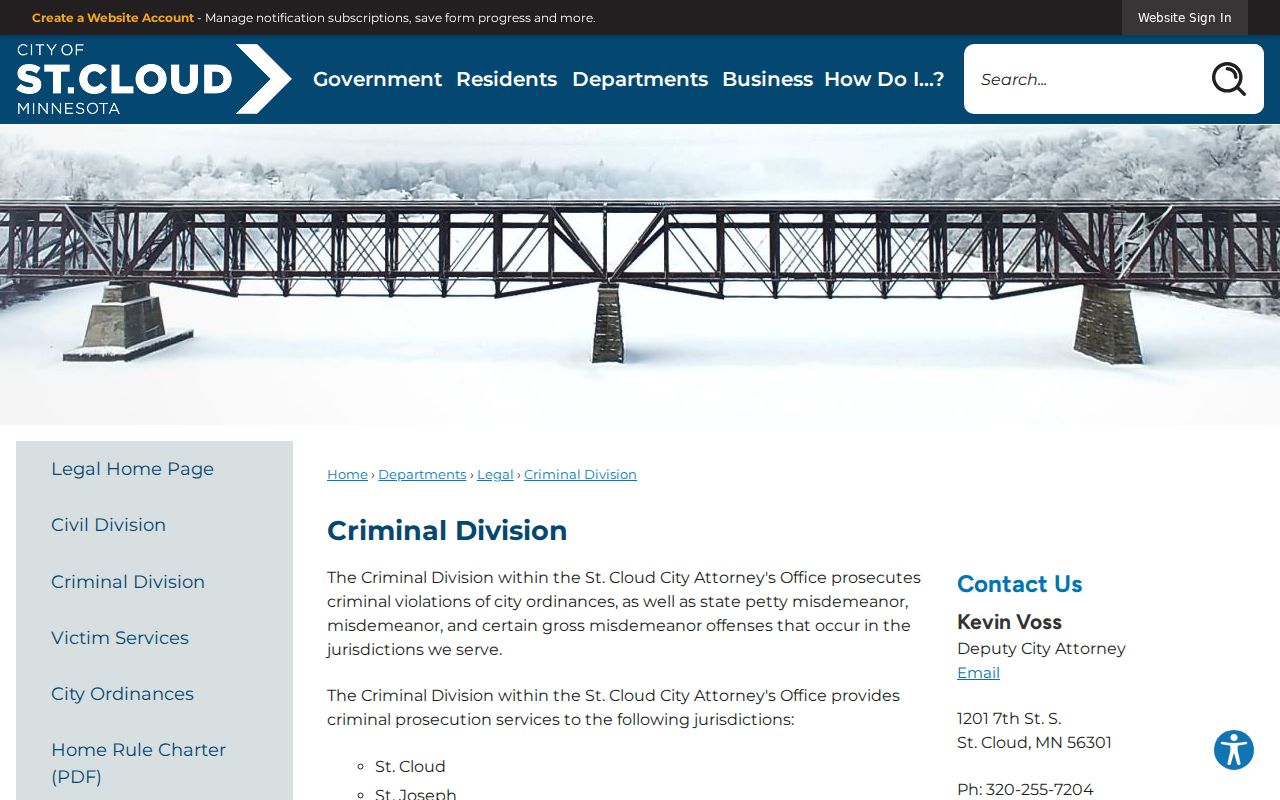
Reading that page first saves a St. Cloud call, since it names which office answers which question.
Types of St. Cloud Warrants
A warrant tied to a St. Cloud case works like any other warrant in the state. The label on the paper tells you what went wrong. Miss one court date and you get a bench warrant; skip a fine and a traffic warrant can follow.
| Warrant Type | How It Arises | Who Issues It |
|---|---|---|
| Arrest warrant | A complaint establishes probable cause and custody is needed | A District Court judge |
| Bench warrant | A required court appearance is missed | The judge on the case |
| Sign-and-release warrant | Minnesota sets a new appearance date instead of bail | The court under Minn. Stat. 629.415 |
| Release-condition warrant | A condition of release is violated | The District Court judge |
An unpaid city citation can reach the same place. Adding a missed court date to it turns a St. Cloud ticket into a warrant question.
Which St. Cloud Courthouse Holds the Warrant Case
Three courthouses serve the St. Cloud area. The offense location decides which one. Call the wrong county administration and you will be told to call another, so match the citation to the county before dialing.
| County | Courthouse | Phone |
|---|---|---|
| Benton | 615 Highway 23, Foley, MN 56329 | 320-968-5205 |
| Stearns | 725 Courthouse Square, St. Cloud, MN 56303 | 320-656-3620 |
| Sherburne | 13880 Highway 10 W, Elk River, MN 55330 | 763-765-4600 |
St. Cloud's official questions page lists the same three routes. The citation is the tiebreaker, not the mailing address.
What a St. Cloud Warrant Record Shows
A St. Cloud case that ends in a warrant produces two records. Readers usually see the shorter one first. The county's published table carries the warrant entry, and the court file carries the case behind it.
| Warrant Number | The identifier printed beside the entry in the county's published table. |
|---|---|
| Subject Name | The published name, matched against a date of birth. |
| Date of Birth | The field that separates two people who share a name. |
| Charge or Offense | A short description plus an offense level. |
| Issuing Court | The county District Court that holds the file, found through the case search. |
| Bond Amount | The published amount, which is not a payment instruction. |
The city that wrote the citation, the arresting officer, and the missed appearance date all sit in the court file. The published table for a St. Cloud warrant does not carry them.
What the Benton Portion of St. Cloud Means for Warrants
St. Cloud crosses county lines, and the numbers prove it. The 2020 Census counted 68,881 people in the full city. Benton County's own description places roughly 6,400 of them inside this county.
For a warrant question, the split matters more than the population count. A St. Cloud resident whose case was filed on the Stearns County side deals with Stearns court administration. The Benton County pages describe only the Benton side of the same city.
Where St. Cloud Warrants Fit With Benton County
A St. Cloud case filed in Benton County runs through the county system. A judge in Foley issues the order. The Benton County Sheriff serves it, and the statewide case search shows the record.
Warrant flow: St. Cloud Police citation › Benton County District Court › Benton County Sheriff service › statewide case record
Everything beyond the city line, from the Sheriff's published listing to the court administration contact and state access rules, appears in the Benton County warrant records overview. St. Cloud readers who need county-level detail can start there.
No St. Cloud Warrant Portal or Roster Was Found
St. Cloud posts public-records links and a records desk contact on its city site. That is where the helpful listings end. The city publishes no warrant database, no most wanted page, and no app for a warrant check. Minnesota's custody notification service does not fill the gap either, because it tracks jail status rather than warrant status. Third-party sites that carry a St. Cloud warrant roster are not official, and their entries are not certified records of any court. So when a search turns up a name, the step stays the same. Confirm with the court that holds the case before treating the listing as accurate.
When a St. Cloud Warrant Case Belongs to Another County
Much of St. Cloud lies outside Benton County. A citation from that side of the city belongs to Stearns or Sherburne instead. The warrant check works the same way; only the offices change.
- Read the county off the citation before calling anyone.
- Use the court administration for that county, not the one nearest to home.
- Search the statewide court records system and filter to the county on the paper.
- Ask a lawyer about timing before an in-person appearance, because custody is a real possibility when an arrest warrant exists.
A county name on a mailing address proves nothing about venue. For a St. Cloud case, the citation itself controls where the case lives.
Public Access to St. Cloud Warrant Records
What can the public see? Court records follow state access rules, while police records follow the state data practices law. Most of what a person wants from St. Cloud is public. Juvenile, sealed, and confidential material stays closed, and police may withhold records tied to an open investigation.
Key Rules:
Minn. Stat. 13.03: public data can be inspected free of charge, and copies cost actual cost.
Minn. Stat. 260B.171: juvenile records are restricted and are not a public warrant source.
Unpaid St. Cloud citations can push a case toward a warrant. The traffic warrant page explains that process and what to expect.